G=-Rtlnk / Derivation Of Thermodynamic Equations - Move the deltag to the left side, we get:
Get link
Facebook
X
Pinterest
Email
Other Apps
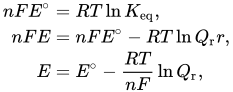
G=-Rtlnk / Derivation Of Thermodynamic Equations - Move the deltag to the left side, we get:. Since at equlibrium condition, k=q (q is the reaction quotient), and deltag=0 , we can put all of these numbers into the formula deltag = deltag° + rt lnq and get the following:. Kinetics, on the other hand, can tell you how fast the reaction will go but doesn't tell you anything about the final state of things once it gets there. Calculating an equilibrium constant from the free energy change. V v m ax m ax m ax s) v v m ax as 'ink = m ax m ax k m ax So if products goes up
Please show me the derivation for the formula relating gibbs free energy change and the reaction quotient. Where ν i is the stoichiometric coefficient (a,b,c,d) for species i, and g fi is the free energy of formation per mole of species i 1. Given equation g=rtlnk where equation g= standard free energy r = gas constant t = temperature in kelvin sca view the full answer We can therefore conclude that any reaction for which. Solving problems involving δg = δg° + rt ln q
The entropy term is therefore subtracted from the enthalpy term when calculating g o for a reaction.
Calculating an equilibrium constant from the free energy change. It is important not to confuse the equilibrium constant with a rate constant of reaction, since they can both be represented by the letter k. `deltag^o` is the gibbs free energy. E° cell is measured in volts (v). Google has many special features to help you find exactly what you're looking for. B when the concentrations or partial pressures of reactants and products are all equal to the standard value, δ 𝐺 ⦵ is the energy that must be absorbed for equilibrium to be reached.; Beside above, how are gibbs free energy and the equilibrium constant related? You must convert your standard free energy value into joules by multiplying the kj value by 1000. The equilibrium constant cannot be 0. Search the world's information, including webpages, images, videos and more. 흔히 대기 따위와 상호 작용으로 일정한 압력과 온도가 유지되므로, 화학 반응 등을 다룰 때 널리 쓴다. Dg = dg0 + rtlnk since dg = 0 at equilibrium, G o is therefore negative for any reaction that is favored by both the enthalpy and entropy terms.
Recall that if k > q, then the reaction proceeds spontaneously to the right as written, resulting in the net. I didn't find it on google, so i decided to turn here. It is important not to confuse the equilibrium constant with a rate constant of reaction, since they can both be represented by the letter k. Dg = dg0 + rtlnk since dg = 0 at equilibrium, You must convert your standard free energy value into joules by multiplying the kj value by 1000.
Solved Hi I Have To Find K Using G Rtlnk The Delta G Chegg Com from media.cheggcdn.com Can the equilibrium constant ever be zero? Gtracing has 10+ cooperative warehouses in the united states, usually shipped within 5 day 흔히 대기 따위와 상호 작용으로 일정한 압력과 온도가 유지되므로, 화학 반응 등을 다룰 때 널리 쓴다. Gibbs energy)는 일정한 압력과 온도를 유지하는 조건 아래 열역학적 계에서 뽑을 수 있는 에너지이다. We know the relationship between g and k: Under conditions of constant temperature and pressure, chemical change will tend to occur in whatever direction leads to a decrease in the value of the gibbs. 1 problem problem3 problem 4 problem 7 problem 8 problem 10 11 problem 13, 16 problem 17 problem 18 problem 20&22 problem 45b! This video took me weeks to do, calling friends and reading the text book i used as a kid.
Gibbs Free Energy Wikipedia from wikimedia.org We can therefore conclude that any reaction for which. 0.002 m ferric nitrate in nitric acid, fe(no3)3 in 1 m hno3 • 0.002 m potassium thiocyanate, kscn • 0.25 m ammonium chromate, (nh4)2c204 • 6 m ammonium hydroxide, nh oh • 0.1 m ferric nitrate, fe(no3)3 • 0.1 m potassium thiocyanate, kscn • 0.1 m silver nitrate, agno3 • 0.1 m sodium nitrate, nano3 • 0.1 m sodium phosphate, na3po4 hazards use proper. Move the deltag to the left side, we get: Sort by date sort by votes a. The entropy term is therefore subtracted from the enthalpy term when calculating g o for a reaction. Given equation g=rtlnk where equation g= standard free energy r = gas constant t = temperature in kelvin sca view the full answer If we know the standard state free energy change, g o, for a chemical process at some temperature t, we can calculate the equilibrium constant for the process at that temperature using the relationship between g o and k. If we know the standard state free energy change, g o, for a chemical process at some temperature t, we can calculate the equilibrium constant for the process at that temperature using the relationship between.
Gtracing has 10+ cooperative warehouses in the united states, usually shipped within 5 day
Kinetics, on the other hand, can tell you how fast the reaction will go but doesn't tell you anything about the final state of things once it gets there. The greater the e° cell of a reaction the greater the driving force of electrons through the system, the more likely the reaction will proceed (more spontaneous). `deltag^o` is the gibbs free energy. This video took me weeks to do, calling friends and reading the text book i used as a kid. I didn't find it on google, so i decided to turn here. Gtracing has 10+ cooperative warehouses in the united states, usually shipped within 5 day Given equation g=rtlnk where equation g= standard free energy r = gas constant t = temperature in kelvin sca view the full answer E° cell is measured in volts (v). According to the second law of thermodynamics, for systems reacting at standard conditions for temperature and pressure (or any other fixed temperature and pressure), there is a general natural tendency to achieve a minimum of the gibbs free energy. Note that this relationship does not give any information about the rate of reaction, since that is dependant on the height of the energy barrier of reaction (the. 0 = deltag° + rt lnk. 0.002 m ferric nitrate in nitric acid, fe(no3)3 in 1 m hno3 • 0.002 m potassium thiocyanate, kscn • 0.25 m ammonium chromate, (nh4)2c204 • 6 m ammonium hydroxide, nh oh • 0.1 m ferric nitrate, fe(no3)3 • 0.1 m potassium thiocyanate, kscn • 0.1 m silver nitrate, agno3 • 0.1 m sodium nitrate, nano3 • 0.1 m sodium phosphate, na3po4 hazards use proper. 기브스 자유 에너지(gibbs free energy) 또는 기브스 에너지(영어:
Move the deltag to the left side, we get: rtlnk. According to the second law of thermodynamics, for systems reacting at standard conditions for temperature and pressure (or any other fixed temperature and pressure), there is a general natural tendency to achieve a minimum of the gibbs free energy.
Comments
Post a Comment